Transmission with Incomplete Tooth Gears - 1


Introduction
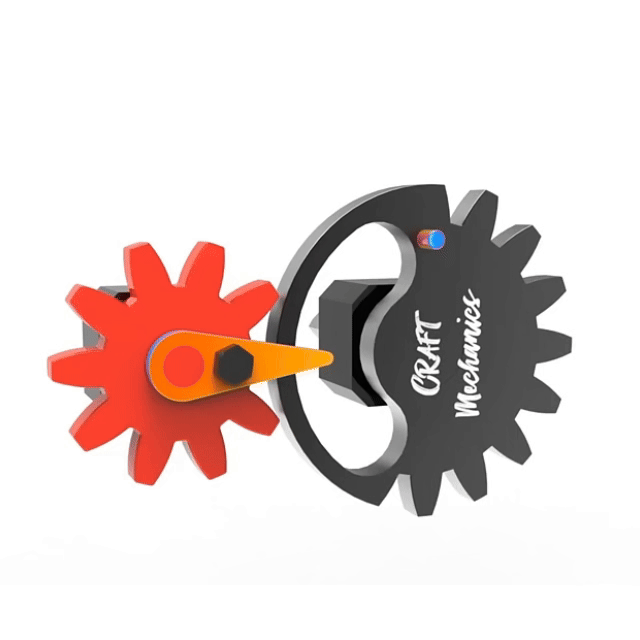
Incomplete tooth gears, also called mutilated gears or partial gears, are specialized mechanical components designed to generate intermittent motion.
Unlike traditional gears with teeth distributed around the full circumference, incomplete gears contain sections where the teeth are intentionally removed. This design allows motion transfer only during specific portions of the rotation cycle.
How the Mechanism Works
When the toothed section of the driving gear meshes with the driven gear, rotational motion is transmitted normally.
However, once the toothless section reaches the contact point, engagement stops and the driven gear remains stationary.
This creates a repeating cycle of:
Motion
Pause (dwell)
Motion again
The mechanism therefore converts continuous rotation into controlled intermittent movement.
Advantages of Incomplete Tooth Gears
These mechanisms offer several engineering advantages:
Simple mechanical construction
Precise timing control
Reliable intermittent motion
Reduced system complexity
Efficient indexing operation
Because the timing depends directly on gear geometry, engineers can precisely determine when the driven gear moves or stops.
Industrial Applications
Incomplete tooth gear mechanisms are commonly used in:
Indexing tables
Packaging machinery
Automated production equipment
Mechanical timers
Printing machines
Motion control systems
These systems are especially useful when periodic stopping is required during a production cycle.
Conclusion
Transmission systems using incomplete tooth gears are a brilliant example of efficient mechanical engineering.
With a simple modification to standard gear geometry, engineers can create highly reliable intermittent motion systems without complex electronics or control mechanisms.
Download the 3D model and explore how this mechanism works in detail.Perfect for engineering students, CAD designers, and mechanical enthusiasts.
🔽 Download here:


Ho letto questo testo con molto interesse e ho trovato diversi spunti utili. Le informazioni sono ben documentate e sembrano affidabili. Ho salvato questo testo per poterlo rileggere in futuro quando ne avrò bisogno. È difficile trovare testi che spieghino questo argomento con tanta chiarezza.